
This is a blog post that I had written over two years ago because it seems that some folks like myself and others decided to revisit older flashcarts, like the Gateway 3DS and Stargate, to further improve and learn about the hardware. There may be more coming soon in the future regarding flashcarts since people like this stuff and would like to see more that they haven't heard of before. With that said, I'm pleased that I have taught you something.
When I was a youngster in 2014, I searched YouTube and GBAtemp frequently till I came across something that blew me away as if I had never seen something like this before; it was called the Gateway 3DS, a flashcart that could play (almost) all games from the 3DS library. I've always wanted one out of curiosity and because I had a 3DS for my birthday, but it was well out of my price range, and despite my best efforts to obtain one, I couldn't find a safer way to get one—that is, I didn't have the patience. I usually discover those dubious and fraudulent 'R4 marketplaces' that display in search results when you search for 'R4' on Google; they 'claim' to have the item you needed, but then they go ahead and do a 180-degree by stealing your credit card information. In addition to getting more than just scammed, it was also hard to get a refund without contacting your payment provider, too, waiting for days or even months to get a response. I remember that I spoke to my neighbor as to how they bought R4 cards; either they couldn't remember or they were hiding something (good times).
Nowadays, as I grew older, I begin to realise that second-hand e-commerce sites like eBay or AliExpress will have everything, and that there are guards in place to protect you from getting ripped off. At this point in time, several years later, I had forgotten about the Gateway 3DS entirely because I continued to use my modded console as it had everything that didn't require one. That is, until one day I stumbled across a listing for a Gateway on eBay for a decent low price. Quickly rush ordered one, and it arrived no less than seven days later.
The red card isn't a fully functional game card, so to speak; rather, it's an accessory that can only be accessed by utilizing Gateway's custom firmware (or more like "patches"), to which it applies them to the system kernel to fool the system into believing that it's a legit game. There was no such thing as Sky3DS or Stargate 3DS, which were 'true' 3DS flashcarts that replicated the same I/O as a retail game cartridge once it had been reverse engineered. But this, however, was 2013; jailbreaking the 3DS was brand-new in the scene, and nobody had seemed to get a custom firmware running unsigned code yet. Gateway was apparently the first to create a custom firmware that only communicates with their flashcarts, and was also the very first to implement EmuNAND support (or 'emulated NAND' support), so that you can keep your system on a lower firmware version as well as your emulated NAND on the latest so that it doesn't break online features or leave you empty-handed, so in simple terms: dual-booting on your 3DS.
As Gateway continued to monopolize the flashcart market, different companies (typically in Mainland China) decided to dabble with what Gateway was doing by releasing new flashcarts in the form of 'clones,' which varied in features that were not implemented yet. One example of this was the MT-Card, developed and shipped around January 2014, which had the ability to add 'multi-ROM' support, so what that means is that you can have more than one ROM on a microSD card, just two months before Gateway had implemented it in their later v2.0 OMEGA update. Furthermore, the MT-Card provided FPGA updates along with proprietary drivers and software for programming via a USB cable. The only people who were not so kind and did very little effort were the R4iDSN team, who blatantly stole Gateway's code without making any changes to the firmware, removing their logo, and claiming it as their own creation; the R4i Gold 3DS Deluxe, Orange3DS, and 3DSLink are all the same carts, albeit with different branding.


The clones that came out after Gateway 3DS (shown here: MT-Card, R4i Gold 3DS Deluxe, 3DSLink (same as R4i Gold))
After the Gateway team (later to be known as 'Team Xecuter') found out about what they were doing, they were not happy, and released a new update (namely v2.0b2), where they deliberately placed malicious code to brick 3DS consoles if it detected a fake cart. This not only upset people greatly who had paid hard-earned money for the clones, but it also triggered if legit Gateway carts were also used or if the SD card was corrupted. After some users on GBAtemp contacted Gateway about the situation, they began to blame the people that followed their competitors, but had made sure to promise everyone that they'll replace any consoles that their firmware has bricked. So far there hasn't been any confirmation that anyone has sent their 3DS systems to them and gotten them back; however, 'hardmods' have made it possible to recover a hard-bricked 3DS (so long as you have a RAW backup of your SysNAND).
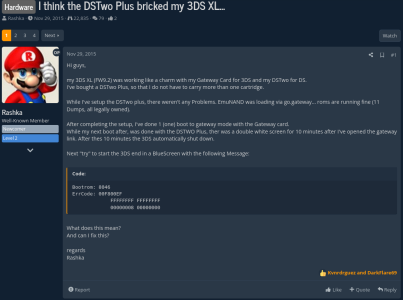
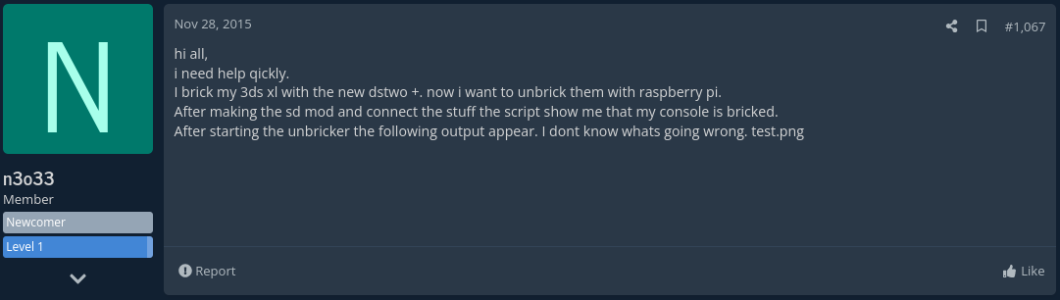
Examples of people who had bricked their systems from using Gateway's official launcher (not just clones, but also originals).
Currently, I'm using Luma3DS and boot9strap installed on my Old 3DS to showcase this working. The Gateway Launcher is being loaded by BootCTR9 which is an ARM9 payload loader for the 3DS. It was stated to work with arm9loaderhax (A9LH for short), but it does however work with the new and improved boot9strap by "SciresM".


Boot screen for Gateway CFW/patches - comparison with original artwork that was stolen by GW.
A history about the red dragon; the illustration featured in the splash screen was designed by Anne Stokes, of whom she creates fantasy-style artwork depicting mythical creatures in a fantasy setting. Gateway not only stole her artwork without her consent, they never gave credit for it on their website or software. And I gotta say, it's quite bold of you to brick clones that steal your code, but then you go on to steal other people's work.
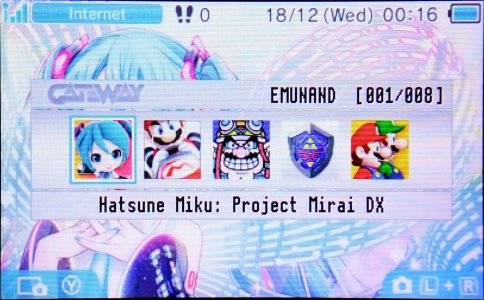
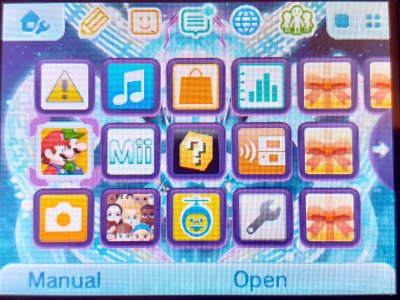
After the splash screen disappears, and even more waiting for the system to boot (since we are on a later system firmware), we are brought to the HOME screen. If you press SELECT, it will display a list of games on the top screen laid out in columns, followed by the mode in which Gateway is launched, which in this case is EmuNAND. Right next to that is the number of games stored on the microSD card. You can select the game of your choice using the left and right D-PAD buttons, which tell you what game is selected at the bottom, and then pressing A will mount it as if you are inserting a retail cartridge. If you press UP on the D-PAD, you can add an in-game button combination to open a cheat menu where you can edit and use cheats for games.
Game saves are stored on the Gateway 3DS cartridge, therefore the game may take some time to load. When you close the game, your save file is saved to your console's SD card, where the Gateway may access it easily whenever you start the game again. Save files are created in the (.SAV) format, which can be transferred to your PC and restored at any time you consider upgrading your SD card, or, in many cases corruption.
The microSD card that I had used for testing the games was a SanDisk 16GB SDHC Class 4 card, and my system is using Gateway's last firmware version, being v4.2 Private Beta.
Game Compatibility List:
Almost all games function flawlessly as expected from a retail cartridge. I finished several stages in WarioWare Gold, including the gyroscope function for the 'Twisted' stages. I never noticed any latency or sound crackling as I progressed through it all. This also applies to Hatsune Miku: Project Mirai DX as I managed to complete several stages in time with the music and got a 'Perfect' rating.
Now, I have yet to attempt games like Pokemon Sun and Moon, because they require the ROM to be patched first since they use the Card-2 type. Later 3DS games use Card-2, and that they differ from Card-1 games in that they save directly to the ROM rather than the save chip; this form of implementation acted as an anti-piracy measure to prevent Gateway flashcards from storing your progress. By patching the ROM, your game save will be stored onto the Gateway as if you were still playing a Card-1 game.
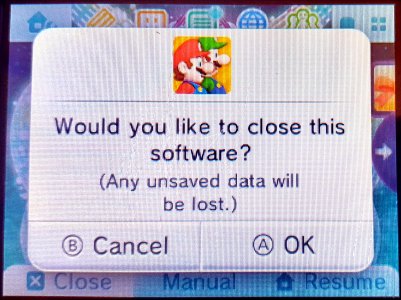
Before hand, I booted Luma3DS with my Gateway EmuNAND and installed them via FBI, then ran them with Gateway's custom firmware. The results may differ, since half of the available homebrew function well, while others cause a soft-lock or return you to the HOME Menu.
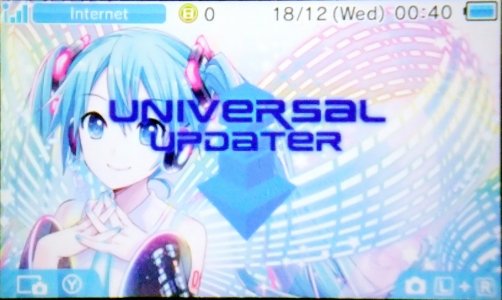
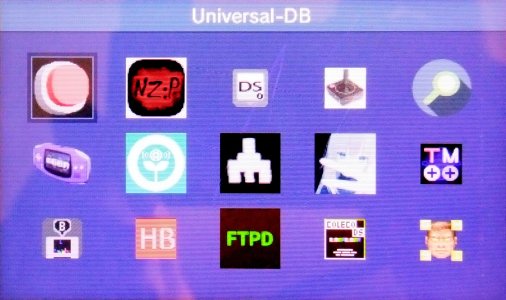
Homebrew Compatibility List:
Pros:
- Works with every retail 3DS game
- Easy-to-operate
- Region free
- Supports up to 11.2 but can be used on later firmwares
Cons:
- Lacks homebrew compatibility
- Does not work with DS-mode software
- Luma3DS is better!
Introduction
A thread that I had made since 2023 about utilizing the Gateway 3DS on the latest system firmware has now gotten 30,000+ views, and people seem to be interested in revisiting obsolete flashcarts like these. And so, I'm going to discuss my experience with the Gateway 3DS, whether it can support homebrew and various upgrades, and if it's still useful to this day.When I was a youngster in 2014, I searched YouTube and GBAtemp frequently till I came across something that blew me away as if I had never seen something like this before; it was called the Gateway 3DS, a flashcart that could play (almost) all games from the 3DS library. I've always wanted one out of curiosity and because I had a 3DS for my birthday, but it was well out of my price range, and despite my best efforts to obtain one, I couldn't find a safer way to get one—that is, I didn't have the patience. I usually discover those dubious and fraudulent 'R4 marketplaces' that display in search results when you search for 'R4' on Google; they 'claim' to have the item you needed, but then they go ahead and do a 180-degree by stealing your credit card information. In addition to getting more than just scammed, it was also hard to get a refund without contacting your payment provider, too, waiting for days or even months to get a response. I remember that I spoke to my neighbor as to how they bought R4 cards; either they couldn't remember or they were hiding something (good times).
Nowadays, as I grew older, I begin to realise that second-hand e-commerce sites like eBay or AliExpress will have everything, and that there are guards in place to protect you from getting ripped off. At this point in time, several years later, I had forgotten about the Gateway 3DS entirely because I continued to use my modded console as it had everything that didn't require one. That is, until one day I stumbled across a listing for a Gateway on eBay for a decent low price. Quickly rush ordered one, and it arrived no less than seven days later.
Flashcart Overview
I can tell that it's one of the later versions since my box is made out of cardboard rather than plastic, and the tray that holds the carts looks to be made of recycled plastic that has been felt-covered over rather than translucent plastic. You are given two cartridges inside, both of which are red and blue. The blue card, which has the same hardware as those $3 Ace3DS+ red cartridges that are typically advertised as "multicarts," is what you use to install the exploit to activate the red card. However, the main attraction, which was how you bought this in the first place, is the red card for loading 3DS games. The limitations is that they need to be encrypted ROM dumps using the file extension (.3DS), they cannot be (.CIA) files which is the common file extension for installing games using FBI; otherwise it won't read them.The red card isn't a fully functional game card, so to speak; rather, it's an accessory that can only be accessed by utilizing Gateway's custom firmware (or more like "patches"), to which it applies them to the system kernel to fool the system into believing that it's a legit game. There was no such thing as Sky3DS or Stargate 3DS, which were 'true' 3DS flashcarts that replicated the same I/O as a retail game cartridge once it had been reverse engineered. But this, however, was 2013; jailbreaking the 3DS was brand-new in the scene, and nobody had seemed to get a custom firmware running unsigned code yet. Gateway was apparently the first to create a custom firmware that only communicates with their flashcarts, and was also the very first to implement EmuNAND support (or 'emulated NAND' support), so that you can keep your system on a lower firmware version as well as your emulated NAND on the latest so that it doesn't break online features or leave you empty-handed, so in simple terms: dual-booting on your 3DS.
As Gateway continued to monopolize the flashcart market, different companies (typically in Mainland China) decided to dabble with what Gateway was doing by releasing new flashcarts in the form of 'clones,' which varied in features that were not implemented yet. One example of this was the MT-Card, developed and shipped around January 2014, which had the ability to add 'multi-ROM' support, so what that means is that you can have more than one ROM on a microSD card, just two months before Gateway had implemented it in their later v2.0 OMEGA update. Furthermore, the MT-Card provided FPGA updates along with proprietary drivers and software for programming via a USB cable. The only people who were not so kind and did very little effort were the R4iDSN team, who blatantly stole Gateway's code without making any changes to the firmware, removing their logo, and claiming it as their own creation; the R4i Gold 3DS Deluxe, Orange3DS, and 3DSLink are all the same carts, albeit with different branding.
The clones that came out after Gateway 3DS (shown here: MT-Card, R4i Gold 3DS Deluxe, 3DSLink (same as R4i Gold))
After the Gateway team (later to be known as 'Team Xecuter') found out about what they were doing, they were not happy, and released a new update (namely v2.0b2), where they deliberately placed malicious code to brick 3DS consoles if it detected a fake cart. This not only upset people greatly who had paid hard-earned money for the clones, but it also triggered if legit Gateway carts were also used or if the SD card was corrupted. After some users on GBAtemp contacted Gateway about the situation, they began to blame the people that followed their competitors, but had made sure to promise everyone that they'll replace any consoles that their firmware has bricked. So far there hasn't been any confirmation that anyone has sent their 3DS systems to them and gotten them back; however, 'hardmods' have made it possible to recover a hard-bricked 3DS (so long as you have a RAW backup of your SysNAND).
Examples of people who had bricked their systems from using Gateway's official launcher (not just clones, but also originals).
The Evolution of Custom Firmware
Thanks to the ever-growing state of custom firmware, Gateway had become redundant even around 2016, but since then, they had continued to push updates to their own firmware up until 2016 with v4.2 private beta. With the latest, you can now run homebrew and install games to the HOME Menu, but in the end they had lost the battle because of free and open-source alternatives, such as Luma3DS (originally AuReiNand) and Pasta CFW, which didn't require external devices like flashcarts but rather involved an SD card and a game exploit like Cubic Ninja. To this day, Luma3DS is the most popular custom firmware up-to-date in 2024 onwards, with updates still being released and supported, as well as new modern exploits being discovered that are easy to facilitate and don't require a game.Testing Gateway
Now for the reason you came, and that is to check if Gateway still functions on a 3DS running the most recent firmware, that being 11.17. And the simple answer is yes. Older system modules can be used to replace newer ones in the form of 'patches' to get Gateway to work again, despite it being over 7-8 years since it last did. With some help from amazing people from the scene, I created a thread to clarify the matter for everyone that with some effort, you can make it happen.Currently, I'm using Luma3DS and boot9strap installed on my Old 3DS to showcase this working. The Gateway Launcher is being loaded by BootCTR9 which is an ARM9 payload loader for the 3DS. It was stated to work with arm9loaderhax (A9LH for short), but it does however work with the new and improved boot9strap by "SciresM".
Boot screen for Gateway CFW/patches - comparison with original artwork that was stolen by GW.
A history about the red dragon; the illustration featured in the splash screen was designed by Anne Stokes, of whom she creates fantasy-style artwork depicting mythical creatures in a fantasy setting. Gateway not only stole her artwork without her consent, they never gave credit for it on their website or software. And I gotta say, it's quite bold of you to brick clones that steal your code, but then you go on to steal other people's work.
After the splash screen disappears, and even more waiting for the system to boot (since we are on a later system firmware), we are brought to the HOME screen. If you press SELECT, it will display a list of games on the top screen laid out in columns, followed by the mode in which Gateway is launched, which in this case is EmuNAND. Right next to that is the number of games stored on the microSD card. You can select the game of your choice using the left and right D-PAD buttons, which tell you what game is selected at the bottom, and then pressing A will mount it as if you are inserting a retail cartridge. If you press UP on the D-PAD, you can add an in-game button combination to open a cheat menu where you can edit and use cheats for games.
Game saves are stored on the Gateway 3DS cartridge, therefore the game may take some time to load. When you close the game, your save file is saved to your console's SD card, where the Gateway may access it easily whenever you start the game again. Save files are created in the (.SAV) format, which can be transferred to your PC and restored at any time you consider upgrading your SD card, or, in many cases corruption.
The microSD card that I had used for testing the games was a SanDisk 16GB SDHC Class 4 card, and my system is using Gateway's last firmware version, being v4.2 Private Beta.
Game Compatibility List:
- Hatsune Miku: Project Mirai DX - WORKS
- New Super Mario Bros. 2 - WORKS
- WarioWare Gold - WORKS
- Mario Kart 7 - WORKS
- The Legend of Zelda: Majora's Mask 3D - WORKS
- Luigi's Mansion (2018) - WORKS
- Shantae and the Pirate's Curse - WORKS
- Animal Crossing New Leaf - WORKS
- Hyrule Warriors Legends - WORKS
Almost all games function flawlessly as expected from a retail cartridge. I finished several stages in WarioWare Gold, including the gyroscope function for the 'Twisted' stages. I never noticed any latency or sound crackling as I progressed through it all. This also applies to Hatsune Miku: Project Mirai DX as I managed to complete several stages in time with the music and got a 'Perfect' rating.
Now, I have yet to attempt games like Pokemon Sun and Moon, because they require the ROM to be patched first since they use the Card-2 type. Later 3DS games use Card-2, and that they differ from Card-1 games in that they save directly to the ROM rather than the save chip; this form of implementation acted as an anti-piracy measure to prevent Gateway flashcards from storing your progress. By patching the ROM, your game save will be stored onto the Gateway as if you were still playing a Card-1 game.
Homebrew
When Gateway released version 2.2 OMEGA of their proprietary firmware, homebrew could be run directly from the console's SD card. I was disappointed to find out that the Gateway card does not accept homebrew with the (.3DS) file format because it requires encryption in the same way as retail ROMs do. Homebrew can be installed using FBI or BigBlueMenu, then launched from the HOME Menu.Before hand, I booted Luma3DS with my Gateway EmuNAND and installed them via FBI, then ran them with Gateway's custom firmware. The results may differ, since half of the available homebrew function well, while others cause a soft-lock or return you to the HOME Menu.
Homebrew Compatibility List:
- FBI - WORKS
- Universal Updater - WORKS (doesn't install CIA files, has to be done manually via FBI)
- Anemone3DS - WORKS
- FourthTube - WORKS
- GameYob - WORKS
- Snes9x 3DS - FAIL (soft-locks on 3DS splash screen)
- mGBA - FAIL (soft-locks on black screen)
- FTPD Classic - WORKS
- The Homebrew Launcher - FAIL (only works with Luma3DS)
Conclusion
What are my thoughts on the GW in 2024, and should you buy one for yourself? Even with the most recent system firmware, the Gateway boots every retail game that I've put onto the microSD card. This is quite useful today if you're considering on picking up an external solution for all of your 3DS game backups. However, given that there's no longer support for the product, and because of how rare they are, I would suggest installing Luma3DS custom firmware. For those considering on buying any 3DS flashcart, then don't.Pros:
- Works with every retail 3DS game
- Easy-to-operate
- Region free
- Supports up to 11.2 but can be used on later firmwares
Cons:
- Lacks homebrew compatibility
- Does not work with DS-mode software
- Luma3DS is better!


